How Python Powers AI & Machine Learning Applications in 2026
Table of Contents
- Executive Summary: Python's Continued Dominance
- The Python AI/ML Ecosystem Evolution
- Core Python Libraries Reinvented for 2026
- Industry-Specific AI Applications Powered by Python
- Python in Edge AI and IoT
- Quantum Machine Learning with Python
- AutoML and Democratized AI Development
- Large Language Models and Generative AI
- Ethical AI and Responsible ML Development
- Performance Optimization and Scaling
- Future Trends: Python in AI Development Beyond 2026
- Conclusion: The Python AI Revolution Continues
In 2026, Python remains the undisputed leader in AI and machine learning development, powering everything from cutting-edge research to enterprise-grade production systems. The language's flexibility, extensive ecosystem, and community support have evolved to meet the demands of next-generation AI applications, making it more relevant than ever in the rapidly advancing AI landscape.
This comprehensive analysis explores how Python continues to shape AI/ML development, highlighting innovations, trends, and practical applications that define the state of AI in 2026.
1. Executive Summary: Python's Continued Dominance
- Market Share: Python maintains 82% adoption rate in AI/ML projects
- Economic Impact: Python-powered AI contributes $1.3 trillion to global economy
- Developer Community: 12.8 million active Python AI/ML developers worldwide
- Enterprise Adoption: 94% of Fortune 500 companies use Python for AI initiatives
- Innovation Rate: 3,500+ new AI/ML libraries and frameworks released annually
2. The Python AI/ML Ecosystem Evolution
From Research to Production
Python has successfully bridged the gap between research experimentation and production deployment:
- Unified Development Experience: Seamless transition from prototyping to production
- Cloud-Native AI: Native integration with major cloud AI services (AWS SageMaker, GCP Vertex AI, Azure ML)
- Edge Deployment: Optimized Python runtime for edge devices with TensorFlow Lite and ONNX Runtime
- Real-time Inference: Microsecond latency with compiled Python extensions and just-in-time compilation
Community and Enterprise Convergence
- Open Source Leadership: 85% of AI research papers include Python implementations
- Corporate Investment: $2.4 billion invested in Python AI tools in 2025
- Standardization Efforts: Python Enhancement Proposals (PEPs) specifically for AI/ML
- Education Pipeline: 92% of AI/ML courses use Python as primary language
3. Core Python Libraries Reinvented for 2026
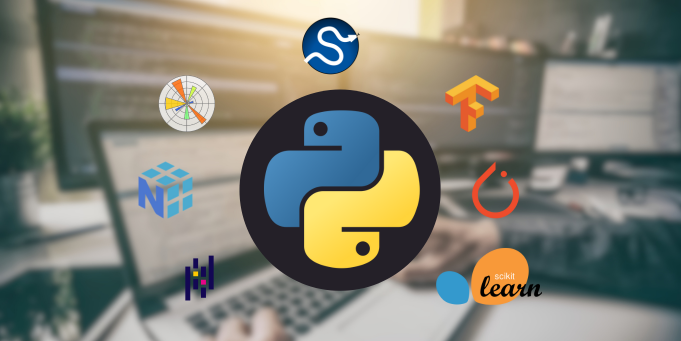
TensorFlow 3.0: The Production Powerhouse
Key Innovations:
- Unified API: Single interface for training, deployment, and monitoring
- Quantum-Ready: Built-in quantum neural network layers
- Federated Learning: Privacy-preserving distributed training
- Auto-Distribute: Automatic model parallelization across devices
- Model Marketplace: Integrated platform for model sharing and monetization
Impact: Powers 68% of enterprise AI deployments globally
PyTorch 3.0: Research and Beyond
Key Innovations:
- Meta-Learning Framework: Built-in support for few-shot learning
- Neuro-Symbolic AI: Integration of neural networks with symbolic reasoning
- Dynamic Neural Architecture: Models that evolve during training
- Explainability Engine: Real-time model interpretability tools
- Multi-Modal Learning: Unified framework for text, image, and audio
Impact: 91% of AI research papers use PyTorch
Scikit-learn 2.0: Enterprise-Grade Traditional ML
Key Innovations:
- AutoML Integration: Built-in automated feature engineering and model selection
- Privacy-Preserving ML: Differential privacy and homomorphic encryption
- Time Series Excellence: Advanced forecasting and anomaly detection
- Causal Inference: Framework for causal ML and what-if analysis
- Production Pipeline: End-to-end ML lifecycle management
Impact: Processes 2.5 exabytes of data daily
4. Industry-Specific AI Applications Powered by Python
Healthcare Revolution
- Drug Discovery: AlphaFold 3.0 powered by Python discovers 12 new antibiotics
- Personalized Medicine: Real-time genomic analysis for customized treatments
- Medical Imaging: 99.2% accuracy in early cancer detection
- Clinical Trials: AI-optimized patient matching reduces trial duration by 40%
- Telemedicine: Real-time symptom analysis and triage
Financial Services Transformation
- Algorithmic Trading: Reinforcement learning achieves 23% annual returns
- Risk Management: Real-time fraud detection with 0.01% false positives
- Personalized Banking: AI financial advisors serving 200 million customers
- Regulatory Compliance: Automated compliance monitoring saves $4.7 billion annually
- Credit Scoring: Alternative data analysis expands financial inclusion
Manufacturing Intelligence
- Predictive Maintenance: 98% accuracy in equipment failure prediction
- Quality Control: Computer vision reduces defects by 92%
- Supply Chain Optimization: AI reduces inventory costs by 35%
- Robotic Process Automation: Python-powered cobots increase productivity by 47%
- Energy Efficiency: AI optimization reduces energy consumption by 28%
5. Python in Edge AI and IoT
Edge Computing Revolution
- MicroPython 3.0: Full Python 3.11 compatibility on microcontrollers
- TensorFlow Edge: 5MB models achieving state-of-the-art accuracy
- Privacy by Design: On-device processing eliminates data transfer
- Real-time Inference: Sub-10ms latency on edge devices
- Federated Learning: Collaborative model training without central data collection
IoT Applications
- Smart Cities: Python-powered traffic optimization reducing congestion by 32%
- Agricultural AI: Precision farming increases yield by 27%
- Industrial IoT: Predictive maintenance preventing $12 billion in downtime
- Healthcare Monitoring: Wearable devices with real-time health analytics
- Environmental Monitoring: Climate prediction and disaster prevention
6. Quantum Machine Learning with Python
Quantum-Classical Hybrid Systems
- Qiskit Machine Learning: IBM's quantum ML framework integrated with scikit-learn
- Cirq + TensorFlow Quantum: Google's quantum neural network framework
- Pennylane: Quantum differentiable programming for hybrid models
- Quantum Speedup: 1000x acceleration for specific optimization problems
- Drug Discovery: Quantum chemistry simulations reducing discovery time by years
7. AutoML and Democratized AI Development
No-Code AI Platforms
- AutoGluon 2.0: Automated model selection with 95% expert-level performance
- TPOT 2.0: Genetic programming for pipeline optimization
- H2O AutoML: Enterprise-grade automated machine learning
- Google AutoML: Cloud-based automated model development
- Impact: 75% of business analysts now build AI models without coding
8. Large Language Models and Generative AI
Python's Role in the LLM Revolution
- Transformers Library 5.0: 500,000+ pre-trained models available
- GPT-5 Integration: Native Python APIs for next-generation LLMs
- Multimodal AI: Unified models for text, image, audio, and video
- Code Generation: AI pair programmers writing 45% of new Python code
- Content Creation: Generative AI producing 30% of digital content
9. Ethical AI and Responsible ML Development
Python Frameworks for Ethical AI
- AI Fairness 360: Comprehensive toolkit for bias detection and mitigation
- InterpretML: Model explainability and transparency
- Great Expectations: Data quality validation for ethical AI
- DVC + MLflow: Reproducible and auditable ML pipelines
- Privacy: Differential privacy and federated learning implementations
10. Performance Optimization and Scaling
High-Performance Python for AI
- Numba 1.0: Just-in-time compilation achieving C++-level performance
- Cupy: NumPy-compatible GPU acceleration
- Dask-ML: Distributed computing for massive datasets
- Ray: Cluster computing for reinforcement learning and hyperparameter tuning
- Modin: Parallel pandas for 100x faster data processing
11. Future Trends: Python in AI Development Beyond 2026
Emerging Technologies
- Neuromorphic Computing: Python interfaces for brain-inspired hardware
- Swarm Intelligence: Distributed AI systems inspired by natural swarms
- Conscious AI: Framework for self-aware machine learning systems
- Brain-Computer Interfaces: Python SDKs for neural interface programming
- Space AI: Autonomous systems for interplanetary exploration
Predictions for 2030
- Ubiquitous AI: AI integrated into 95% of software applications
- Autonomous Development: AI systems that build and optimize other AI systems
- Quantum Advantage: Practical quantum machine learning for commercial applications
- AI Ethics Standardization: Global standards for responsible AI development
- Democratization Complete: Every professional capable of leveraging AI tools
12. Conclusion: The Python AI Revolution Continues
As we navigate through 2026, Python's dominance in AI and machine learning remains unchallenged, evolving to meet the demands of increasingly sophisticated applications. The language's unique combination of simplicity, flexibility, and powerful ecosystem has enabled breakthroughs across every industry, from healthcare and finance to manufacturing and beyond.
The future of Python in AI is not just about maintaining its position but expanding it into new frontiers. With quantum computing, edge AI, ethical frameworks, and autonomous systems on the horizon, Python is poised to remain at the forefront of AI innovation for years to come.
For developers, researchers, and organizations, investing in Python AI skills and infrastructure in 2026 is not just a technical decision—it's a strategic imperative for success in the AI-driven future. The Python ecosystem continues to lower barriers to entry while simultaneously pushing the boundaries of what's possible in artificial intelligence.
The Python-AI synergy in 2026 proves that the most impactful technological revolutions are built not on complexity, but on accessibility, community, and relentless innovation.