Table of Contents
- Introduction
- What is AI in Healthcare?
- Why AI is Important in Healthcare
- Smart Diagnostics with AI
- Personalized Treatment Using AI
- Virtual Healthcare Assistants
- AI in Hospital Management
- AI-Powered Medical Imaging
- Benefits of AI Healthcare Solutions
- Challenges of Artificial Intelligence in Healthcare
- Future of Healthcare AI Technology
- Conclusion
Introduction
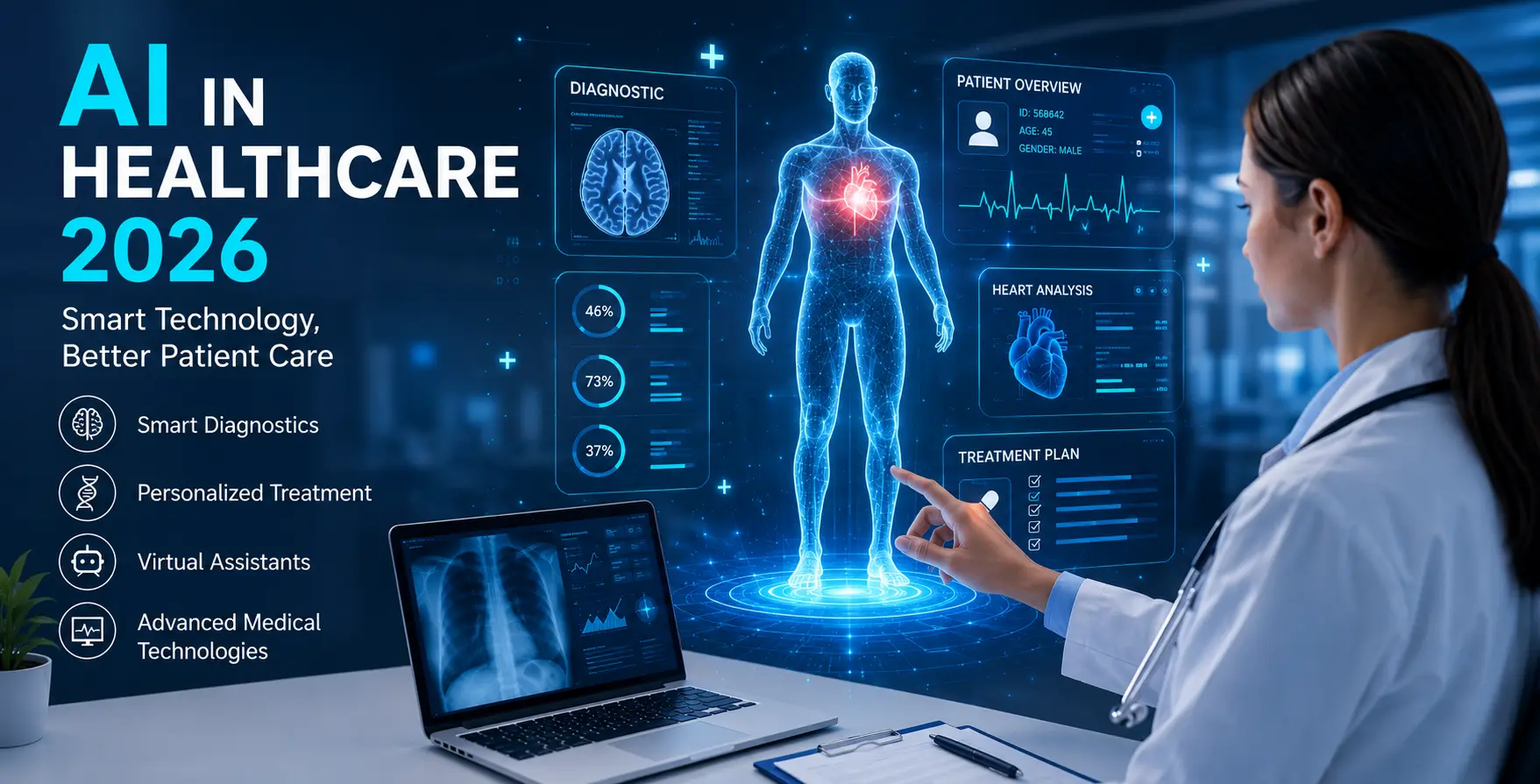
The healthcare industry is changing rapidly with the help of modern technology. One of the biggest innovations in recent years is Artificial Intelligence in Healthcare. Hospitals, clinics, and healthcare providers are now using AI tools to improve patient care and increase efficiency.
In 2026, AI in Healthcare 2026 is becoming more advanced than ever before. From detecting diseases early to helping doctors create personalized treatment plans, AI is transforming the medical industry in multiple ways.
Healthcare organizations are investing heavily in Healthcare AI Technology to reduce human error, improve diagnosis speed, and provide better patient experiences.
- Improves healthcare efficiency
- Supports doctors with accurate diagnosis
- Enhances patient care and treatment
What is AI in Healthcare?
AI in healthcare refers to the use of artificial intelligence technologies in medical services and healthcare systems. AI systems can analyze large amounts of medical data, identify patterns, and provide intelligent recommendations.
Artificial Intelligence in Healthcare includes technologies like machine learning, natural language processing, and predictive analytics. These technologies help healthcare professionals make faster and more accurate decisions.
Today, AI Healthcare Solutions are being used in hospitals, laboratories, research centers, and telemedicine platforms.
- Analyzes medical data quickly
- Helps doctors make better decisions
- Automates repetitive healthcare tasks
Why AI is Important in Healthcare
The healthcare industry handles massive amounts of patient data every day. Managing this data manually can be difficult and time-consuming. This is where Healthcare AI Technology becomes extremely useful.
AI can identify diseases at an early stage, improve treatment accuracy, and reduce operational costs. It also helps healthcare providers deliver faster services to patients.
In AI in Healthcare 2026, hospitals are increasingly relying on automation and intelligent systems to improve medical outcomes.
- Reduces medical errors
- Improves treatment accuracy
- Saves time for healthcare professionals
- Enhances patient experience
Smart Diagnostics with AI
One of the biggest advantages of Artificial Intelligence in Healthcare is smart diagnostics. AI-powered systems can analyze medical reports, lab results, and scans much faster than traditional methods.
Doctors are using AI to detect diseases like cancer, diabetes, heart disease, and neurological disorders at earlier stages.
AI Healthcare Solutions improve diagnosis accuracy and help doctors provide better treatment plans for patients.
- Detects diseases earlier
- Improves diagnosis accuracy
- Analyzes medical reports efficiently
Personalized Treatment Using AI
Every patient is different, and treatment should be personalized according to individual health conditions. Healthcare AI Technology helps doctors create customized treatment plans using patient history and medical data.
AI systems can analyze patient behavior, genetic information, and previous treatment results to recommend the best possible care.
AI in Healthcare 2026 is helping healthcare providers move toward precision medicine and personalized healthcare services.
- Provides personalized care
- Improves treatment effectiveness
- Uses patient data intelligently
Virtual Healthcare Assistants
Virtual healthcare assistants are becoming more popular in modern healthcare systems. These AI-powered assistants help patients schedule appointments, answer medical questions, and provide medication reminders.
Artificial Intelligence in Healthcare is improving communication between patients and healthcare providers through chatbots and virtual assistants.
These smart systems also reduce the workload of hospital staff and improve patient engagement.
- Available 24/7 for patients
- Provides quick medical assistance
- Reduces administrative workload
AI in Hospital Management
Hospitals are using AI Healthcare Solutions to improve daily operations and resource management. AI systems help manage patient records, hospital inventory, and appointment scheduling.
Healthcare AI Technology also helps hospitals predict patient admission rates and optimize staff allocation.
With AI-powered automation, hospitals can reduce operational costs and improve efficiency.
- Improves hospital operations
- Automates administrative tasks
- Optimizes resource management
AI-Powered Medical Imaging
Medical imaging is another area where AI in Healthcare 2026 is making a huge impact. AI tools can analyze X-rays, MRI scans, and CT scans with high accuracy.
Radiologists use AI systems to identify abnormalities faster and improve patient diagnosis.
Artificial Intelligence in Healthcare helps reduce human error and improves the speed of medical imaging analysis.
- Analyzes scans faster
- Improves imaging accuracy
- Supports radiologists with better insights
Benefits of AI Healthcare Solutions
AI Healthcare Solutions provide multiple benefits for both patients and healthcare organizations. These technologies improve efficiency, reduce costs, and enhance healthcare quality.
Healthcare providers can use AI systems to improve patient satisfaction and deliver better healthcare experiences.
| Benefits |
Impact |
| Faster Diagnosis |
Quick treatment decisions |
| Automation |
Reduced manual workload |
| Personalized Treatment |
Better patient outcomes |
| Data Analysis |
Improved medical insights |
Challenges of Artificial Intelligence in Healthcare
Although AI is transforming healthcare, there are still some challenges that organizations must address. Data privacy, security concerns, and implementation costs remain important issues.
Healthcare providers must also ensure that AI systems are reliable, ethical, and transparent.
- Data privacy concerns
- High implementation costs
- Need for skilled professionals
- Ethical and legal considerations
Future of Healthcare AI Technology
The future of Healthcare AI Technology looks very promising. In the coming years, AI systems will become more advanced and integrated into healthcare services worldwide.
AI in Healthcare 2026 is only the beginning of a larger transformation in the medical industry. Future innovations may include robotic surgeries, predictive healthcare systems, and fully automated patient monitoring.
Healthcare organizations that adopt AI technologies early will gain significant advantages in patient care and operational efficiency.
- Growth of predictive healthcare
- Advanced robotic surgeries
- Smarter patient monitoring systems
Conclusion
Artificial Intelligence in Healthcare is revolutionizing the medical industry by improving diagnostics, treatment, hospital management, and patient experiences.
AI in Healthcare 2026 is helping healthcare providers deliver faster, smarter, and more personalized care through advanced Healthcare AI Technology.
As AI Healthcare Solutions continue to evolve, the future of healthcare will become more efficient, accessible, and patient-focused.