Table of Contents
- Executive Summary
- Historical Evolution: The NLP Journey
- Architectural Differences
- Training Paradigms
- Performance Comparison
- Practical Applications
- Resource Requirements Comparison
- Strengths and Limitations
- Hybrid Approaches: Best of Both Worlds
- Future Directions
- Choosing the Right Approach
- Conclusion
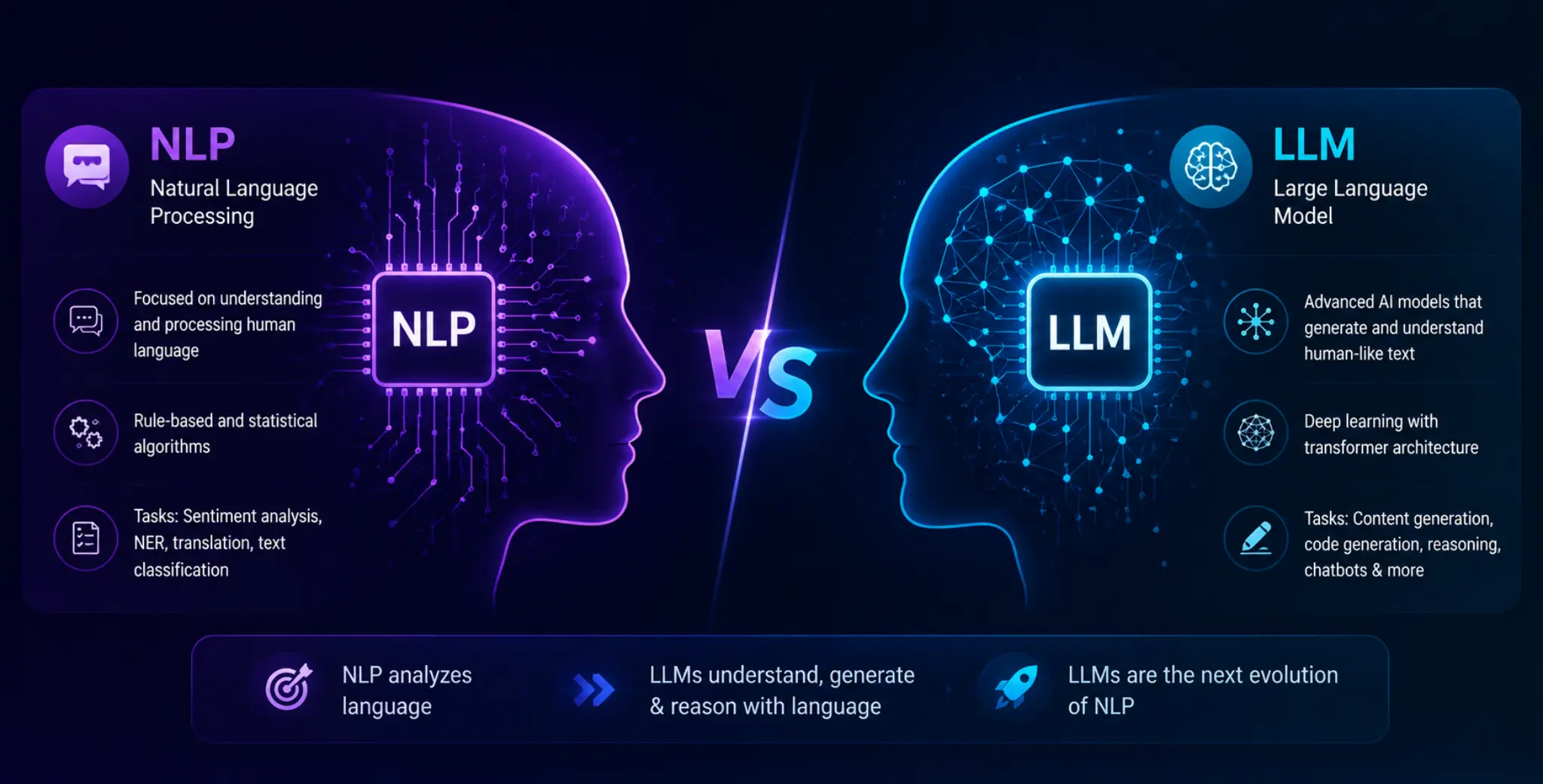
The natural language processing (NLP) landscape has undergone a seismic shift with the advent of Large Language Models (LLMs). What started as rule-based systems and statistical models has evolved into transformer-based architectures that understand and generate human-like text. This comprehensive comparison explores the fundamental differences between traditional NLP approaches and modern LLMs, and what this evolution means for the future of AI.
Executive Summary
- Parameter Scale: Traditional NLP models: thousands to millions | LLMs: billions to trillions
- Training Data: Traditional: domain-specific, curated datasets | LLMs: internet-scale, diverse corpora
- Architecture: Traditional: task-specific architectures | LLMs: general-purpose transformer architecture
- Learning Approach: Traditional: supervised, feature engineering | LLMs: self-supervised, end-to-end learning
- Computational Requirements: Traditional: modest resources | LLMs: massive computational infrastructure
1. Historical Evolution: The NLP Journey
The Traditional NLP Era (1960s-2010s)
- Rule-Based Systems (1960s-1980s): Handcrafted linguistic rules and patterns
- Statistical Methods (1990s-2000s): Hidden Markov Models, n-grams, Naive Bayes
- Early Machine Learning (2000s-2010s): SVMs, CRFs, early neural networks
- Word Embeddings Era (2010s): Word2Vec, GloVe, FastText
The Modern LLM Era (2017-Present)
- Transformer Revolution (2017): Attention is All You Need paper
- Pre-trained Models (2018-2019): BERT, GPT-2, T5
- Large Scale Era (2020-Present): GPT-3/4, PaLM, LLaMA, Claude
- Multimodal Expansion (2022-Present): Vision-language models, audio integration
2. Architectural Differences
Traditional NLP Architectures
Key Characteristics:
- Modular Design: Separate components for tokenization, parsing, feature extraction
- Task-Specific Models: Different architectures for different tasks
- Feature Engineering: Manual extraction of linguistic features
- Pipeline Approach: Sequential processing through multiple stages
LLM Architecture (Transformer-Based)
Key Characteristics:
- Unified Architecture: Single model handles multiple tasks
- Self-Attention Mechanism: Global context understanding
- Positional Encoding: Understanding word order and relationships
- Scalable Design: Architecture scales with data and parameters
3. Training Paradigms
Traditional NLP Training
| Aspect |
Traditional NLP |
LLMs |
| Data Requirements |
Small, labeled datasets |
Massive, unlabeled text corpora |
| Training Approach |
Supervised learning with explicit labels |
Self-supervised learning with next-token prediction |
| Feature Engineering |
Extensive manual feature creation |
Automatic feature learning |
| Training Time |
Hours to days |
Weeks to months |
| Computational Cost |
Modest (single GPU to small cluster) |
Massive (hundreds to thousands of GPUs/TPUs) |
4. Performance Comparison
Accuracy and Capabilities
- Task-Specific Accuracy:
- Traditional NLP: High accuracy on narrow, well-defined tasks
- LLMs: Excellent performance across diverse tasks with zero/few-shot learning
- Generalization:
- Traditional NLP: Limited to trained domains
- LLMs: Strong cross-domain generalization
- Language Understanding:
- Traditional NLP: Surface-level pattern recognition
- LLMs: Deep semantic understanding and reasoning
Benchmark Performance
| Task |
Best Traditional NLP (2018) |
Modern LLMs (2024) |
Improvement |
| Question Answering (SQuAD 2.0) |
86% F1 Score |
95%+ F1 Score |
~10% absolute improvement |
| Text Classification |
92-95% Accuracy |
96-99% Accuracy |
3-7% absolute improvement |
| Named Entity Recognition |
89% F1 Score |
94%+ F1 Score |
5%+ absolute improvement |
| Machine Translation |
30-35 BLEU Score |
40-45 BLEU Score |
~10 BLEU points improvement |
| Text Generation (Human Evaluation) |
60% Human Preference |
85%+ Human Preference |
25%+ absolute improvement |
5. Practical Applications
Where Traditional NLP Still Excels
- Resource-Constrained Environments: Edge devices, mobile applications
- Domain-Specific Tasks: Medical coding, legal document parsing
- Deterministic Systems: Where 100% accuracy is required
- Real-Time Processing: Low-latency requirements
- Data-Poor Domains: Limited training data available
Where LLMs Dominate
- Creative Tasks: Content generation, storytelling, poetry
- Complex Reasoning: Multi-step problem solving
- Conversational AI: Chatbots, virtual assistants
- Code Generation: Programming assistance, debugging
- Multimodal Tasks: Image captioning, video understanding
6. Resource Requirements Comparison
Infrastructure Needs
| Resource |
Traditional NLP Model |
Large Language Model |
| Training Data |
1MB - 1GB |
100GB - 10TB+ |
| Model Size |
1KB - 100MB |
100MB - 1TB+ |
| Training Time |
Minutes to hours |
Days to months |
| Inference Hardware |
CPU or single GPU |
Multiple high-end GPUs/TPUs |
| Energy Consumption |
Negligible to moderate |
Very high |
| Cost to Train |
$10 - $10,000 |
$100,000 - $10M+ |
7. Strengths and Limitations
Traditional NLP Strengths
- Interpretability: Easier to understand decision-making process
- Efficiency: Low computational requirements
- Reliability: Predictable performance on specific tasks
- Data Efficiency: Works well with limited data
- Customizability: Easy to modify for specific needs
Traditional NLP Limitations
- Limited Generalization: Poor performance on unseen data
- Fragility: Breaks with slight input variations
- Labor Intensive: Requires extensive feature engineering
- Scalability Issues: Hard to scale across multiple languages/tasks
LLM Strengths
- Versatility: Single model for multiple tasks
- Generalization: Strong performance on diverse inputs
- Few-Shot Learning: Learns from minimal examples
- Creative Generation: Produces novel, coherent content
- Context Understanding: Deep understanding of language nuances
LLM Limitations
- Computational Cost: High inference latency and cost
- Black Box Nature: Hard to interpret decisions
- Hallucinations: Generates plausible but incorrect information
- Environmental Impact: High energy consumption
- Training Complexity: Requires specialized expertise and infrastructure
8. Hybrid Approaches: Best of Both Worlds
Modern Solutions Combining Both Paradigms
- Retrieval-Augmented Generation (RAG): LLMs + traditional information retrieval
- LLM-Powered Feature Extraction: Using LLMs to enhance traditional models
- Ensemble Methods: Combining predictions from both approaches
- Knowledge Distillation: Training smaller models from LLMs
- Modular Systems: LLMs for understanding, traditional models for execution
9. Future Directions
Evolution of LLMs
- Efficient Architectures: Reducing computational requirements
- Specialized LLMs: Domain-specific large models
- Multimodal Integration: Beyond text to images, audio, video
- Reasoning Capabilities: Improved logical and mathematical reasoning
- Personalization: Models adapting to individual users
Traditional NLP Renaissance
- Lightweight Alternatives: Efficient models for edge computing
- Explainable AI: Transparent decision-making systems
- Hybrid Systems: Combining symbolic and neural approaches
- Low-Resource Languages: Focus on under-represented languages
10. Choosing the Right Approach
Decision Framework
- Choose Traditional NLP When:
- Limited computational resources available
- High interpretability is required
- Working with domain-specific, structured data
- Real-time, low-latency processing needed
- Budget constraints are significant
- Choose LLMs When:
- Dealing with diverse, unstructured data
- Creative generation is required
- Need strong generalization across tasks
- Resources for training/inference are available
- Working on cutting-edge applications
Conclusion
The evolution from traditional NLP to Large Language Models represents one of the most significant paradigm shifts in artificial intelligence. While LLMs have demonstrated remarkable capabilities and pushed the boundaries of what's possible with language understanding and generation, traditional NLP approaches still have their place in specific applications where efficiency, interpretability, and reliability are paramount.
The key takeaway is not about choosing one over the other, but understanding their respective strengths and limitations. The most effective modern NLP systems often combine elements of both approaches, leveraging LLMs for their broad understanding and creative capabilities while using traditional methods for specific, well-defined tasks where they excel.
As we move forward, the field will likely see continued convergence, with LLMs becoming more efficient and traditional approaches becoming more sophisticated. The future of NLP lies in hybrid systems that combine the scalability and generality of LLMs with the precision and efficiency of traditional methods.
The Bottom Line: Traditional NLP and LLMs are complementary technologies in the AI toolkit. The choice between them should be driven by specific use cases, resource constraints, and performance requirements rather than technological trends alone.