Vectorless RAG: When Retrieval Doesn’t Need Embeddings
Table of Contents
- Introduction
- How RAG Became “Vector First”
- Where Vector RAG Starts Breaking
- Enter Vectorless RAG
- Vector RAG vs Vectorless RAG (Practical View)
- Where Each Approach Actually Works
- Building Smarter Systems (Hybrid Thinking)
- Final Perspective
Introduction
Retrieval-Augmented Generation (RAG) has rapidly become a core design pattern in modern AI retrieval systems. It enables Large Language Models to move beyond static knowledge by connecting them with external data sources.
At a high level, the idea is simple: retrieve relevant information, provide it as context to the model, and generate a grounded response.
However, the way this retrieval is implemented has become increasingly standardized. Today, most RAG architecture patterns rely on embeddings and vector search as a default approach.
While this assumption works well in many scenarios, it has also led to unnecessary complexity in some AI retrieval systems where simpler approaches could perform better.
How RAG Became “Vector First”
The shift toward vector-based retrieval was driven by limitations in traditional keyword-based search, especially when handling synonyms, contextual meaning, and ambiguous queries.
Embedding models enabled semantic similarity, allowing RAG systems to understand relationships like “revenue growth” and “increase in sales.”
As a result, modern RAG architecture evolved into a common pipeline:
- Chunk documents
- Generate embeddings
- Store in vector databases
- Perform similarity search
This approach is powerful but not always optimal.
Where Vector RAG Starts Breaking
As AI retrieval systems scale, vector-based RAG introduces several challenges.
Computational overhead increases as every piece of data must be embedded. Infrastructure becomes more complex with vector databases and indexing strategies. Latency also increases due to similarity search operations.
Another key limitation is explainability. It is often difficult to understand why a specific result was retrieved.
The biggest mismatch appears when RAG is applied to structured or deterministic queries where exact results are required.
Enter Vectorless RAG
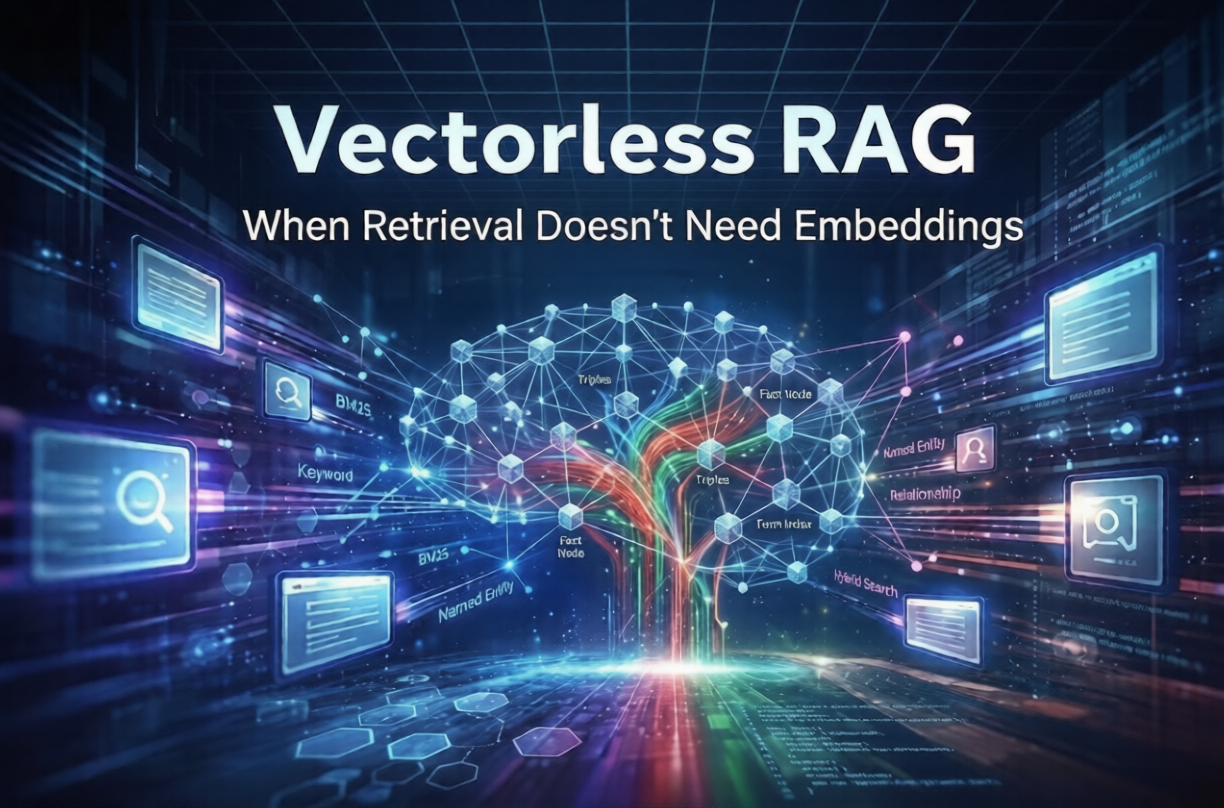
Vectorless RAG is based on a simple idea: not all retrieval problems require semantic understanding — some require precision.
Instead of embeddings, it uses direct retrieval techniques:
- Keyword-based ranking (BM25)
- SQL queries
- Metadata filtering
- Rule-based systems
This makes the system faster, simpler, and more transparent.
Vector RAG vs Vectorless RAG (Practical View)
| Dimension |
Vector RAG |
Vectorless RAG |
| Core Idea |
Semantic similarity |
Exact retrieval |
| System Complexity |
Higher |
Lower |
| Cost |
Higher |
Lower |
| Explainability |
Limited |
Strong |
Where Each Approach Actually Works
Vector RAG works best with unstructured data and open-ended queries that require contextual understanding.
Vectorless RAG is more effective when dealing with structured data and precise queries where accuracy is critical.
Building Smarter Systems (Hybrid Thinking)
Modern RAG architecture benefits from combining both approaches.
- Use vector search for ambiguous queries
- Use direct retrieval for precise queries
This hybrid approach allows AI retrieval systems to balance performance, accuracy, and complexity.
Final Perspective
Retrieval Augmented Generation continues to evolve as a core part of AI retrieval systems.
While vector-based methods are powerful, they are not always necessary. Vectorless RAG highlights the importance of choosing the right approach based on the problem.
Ultimately, effective RAG architecture is not about using more complex tools, but about aligning the solution with the specific requirements of the system.